
9.1 Significance Test
Significance test is testing the claim or the hypothesis about population parameter such as proportion $p$ or mean $\mu$.
Hypotheses
Null Hypothesis $(H_0)$ : Original claim; claim we are finding evidence against
Example : A claim that a population parameter is certain value
Alternative Hypothesis $(H_a)$ : Claim that original claim is wrong; A claim we are finding evidence for
Example : A claim that a (less or greater) than certain value
One sided alternative hypothesis : Population parameter is less or greater null value (specifially less or greater; directional)
Two sided alternative hypothesis : Population parameter is not the null value (no matter greater or less)
P-value : probability of getting evidence for the alternative hypothesis $H_a$
Significance Level $\alpha$ : boundary value for deciding if observed result happened merely by chance or not
- P-value $< \alpha \to$ reject $H_0$, Convincing evidence for $H_a$
- P-value $> \alpha \to$ No convincing evidence for $H_a$
- 0.05 (5%) is often used for
Significance Level$\alpha$
Interpretation of P-value
Assuming $H_0$ is true, There is P-value(actual value) probability of getting sample statistic (mean, proportion, etc) of sample statistic(actual value) or greater/less.
Example: Assuming that the true mean in context is 120, There is 0.1 probability of getting sample mean of 100 or less.
Errors
Type I Error : Rejected H0 even though H0 is true.
Type II Error : Fail to reject H0 when H0 is not ture (= when Ha is true).
Significance Level $\alpha$ is also a probability of getting
Type I Errorbecause we can still get p-value under significance by chance althought it is rare
Requiring more evidence or having lower significance level means that it is less likely to find convincing evidence, which means it is more likely to have Type II Error.
The opposite will increase the chance of having Type I Error
9.2 Population Porportion Test
Conditions
- Random - Random Sample
- Independence (10% Condition) - $n \leq 0.1N$
- Normality (Laege Counts) - $np \geq 10, \space n(1-p) \geq 10$
Standardized Test
Standardized Test Statistic : How far a sample statistic is from the parameter in standardized unit, assuming the null hypothesis $H_0$ is true
Four step process of significance test
- State
- Plan
- Do
- Conclude
Power
Power : Probability that the test will find convincing evidence for alternative hypothesis $H_a$ when some alternative value for the parameter is true
In other words, the probability of finding convincing evidence assuming the true parameter is some other value than null value.
| $H_0$ is true | $H_a$ is true | |
|---|---|---|
| Reject $H_0$ | Type I Error | Power |
| Fail to reject $H_0$ | Waste of money | Type II error |
Power will be larger when
- Larger sample size n (less varibility)
- Larger significance Level $\alpha$ (more chance to find convincing evidence)
- Larger effective size (the null and alternative parameter values are more farther apart)
Example:
- Let $H_0 : \mu = 1$
- $H_a : \mu > 1$
the power will be the probability of finding convincing evidence for $H_a$ assuming the true mean is 2.
Relationship with Type II Error
\[\begin{gather} \text{Power} = 1 - P(\text{Type II Error}) \\ \text{or} \\ P(\text{Type II Error}) = 1- \text{Power} \end{gather}\]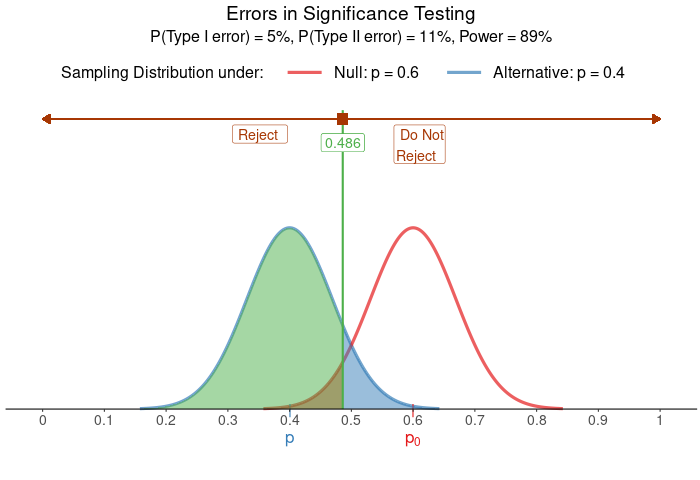 Power and Error relationship
Picture from Applet: https://istats.shinyapps.io/power/
9.3 Population Proportion Difference Test
Conditions
Check conditions for both $p_1$ and $p_2$
- Random - Random Sample
- Independence (10% Condition) - $n \leq 0.1N$
- Normality (Large Counts) - $np_0 \geq 10, \space n(1-p_0) \geq 10$
Combined proportion
Assuming $p_1 = p_2$,
\[\hat p_C = \frac{X_1 + X_2}{n_1 + n_2}\]When we assume $p_1 = p_2$, we are thinking that there was no difference in two samples. So, we are thinking like we got one larger sample with the size of $n_1 + n_2$.
This also decreases the variability of sampling distribution of proportion since we are increasing the sample size, and it would likely be closer to the true proportion if null hypothesis of $p_1 = p_2$ is true.
Standardized test Statistic
\[\begin{gather} z_{\hat p_1 - \hat p_2} = \frac{(\hat p_1 - \hat p_2) - (p_1 - p_2)}{\sqrt{\frac{\hat p_C (1- \hat p_C)}{n_1} + \frac{\hat p_C(1- \hat p_C)}{n_2}}} \end{gather}\]Since we are assuming that $p_1 = p_2$, the equation can be simplified like below.
\[\begin{gather} z_{\hat p_1 - \hat p_2} = \frac{\hat p_1 - \hat p_2}{\sqrt{\frac{\hat p_C (1- \hat p_C)}{n_1} + \frac{\hat p_C(1- \hat p_C)}{n_2}}} \end{gather}\]